Why "General AI" Fails Healthcare: The Critical Need for Domain-Specific Neural Training
Discover why general AI models like GPT-4o fall short in healthcare and how Fusion AI’s domain-specific neural training delivers clinical precision.
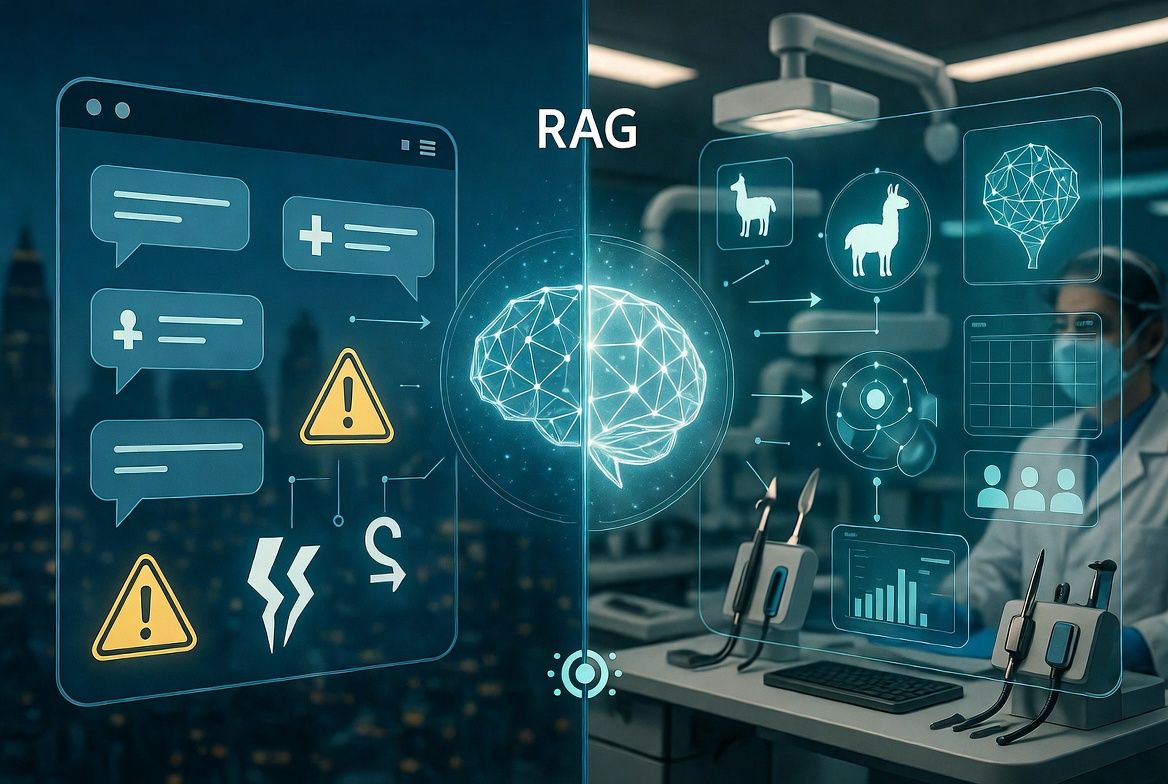
In 2026, every business has a chatbot. But in the high-stakes world of New York healthcare, "general" isn't good enough. If you’re a dentist in Manhattan or a surgical specialist in Brooklyn, you’ve likely seen the limitations of generic AI models like GPT-4o or Claude when they try to handle patient inquiries.
They might be polite, but they often lack the clinical nuance, regulatory compliance, and practice-specific "brain" required to actually close a $5,000 lead.
Here is why general-purpose AI is failing healthcare providers and how Fusion AI’s domain-trained architecture is setting a new standard.
1. The Hallucination Hazard in Clinical Scripts
General AI is trained on the entire internet. While that makes it great at writing poetry, it makes it dangerous for patient education. When a patient calls at 11 PM asking about NightLase airway tightening, a general AI might "hallucinate" details—overpromising results or misexplaining the science of collagen contraction.
The Fusion AI Solution: We utilize Retrieval-Augmented Generation (RAG). Our agents aren't "guessing" based on their training data; they are grounded in your specific clinical protocols. If your practice uses Dr. Sam’s specific NightLase settings, the AI only speaks from that verified knowledge base.
2. Failure to Understand "Dental Intent"
A general AI sees a call as a "chat." A specialized dental agent sees a call as a Conversion Path.
- General AI: "Yes, we do implants. Would you like our address?"
- Neural Core AI: "I see you're asking about implants. Dr. Nazarov specializes in minimally invasive placements. We’re currently offering a $49 evaluation that unlocks a $749 treatment credit. Would you like to see if we have an opening this Thursday morning?"
Without domain training, an AI cannot identify "High-Intent" keywords or navigate the complex business logic of a high-ticket dental practice.
3. The "Latency Gap" in Complex Reasoning
General models are heavy. When they try to process a complex medical question, the "Turn-around Time" often exceeds 2 seconds. In the fast-paced NYC market, that silence feels robotic and breaks trust.
The Fusion AI Solution: By using hyper-efficient models like Llama 3.1 optimized on Groq LPUs, we achieve sub-500ms latency. Because our models are specialized for healthcare "reasoning," they don't have to "think" about the rest of the world—they only think about your practice.
4. Integration vs. Isolation
General AI lives in a vacuum. It doesn't know your 2:00 PM slot just opened up in Dentrix. It doesn't know that a patient in Open Dental has a balance due.
True "Impact" AI requires bi-directional integration. A specialized agent needs to "read" your schedule and "write" the appointment. General-purpose bots simply aren't built to navigate the secure, complex APIs of practice management software.
The Verdict: Specialized Intelligence is the Only Path Forward
In 2026, patients can tell the difference between a "Chatbot" and a "Clinical Assistant." One is a toy; the other is a team member. For NYC practitioners looking to scale, the choice isn't just "AI or no AI"—it's whether you want an AI that understands the soul of your practice.
Ready to deploy a specialized Neural Core in your neighborhood? See if your area is still available.

Kanat Nazarov
Systems Architect & Founder
Kanat Nazarov is a Full-Stack Developer and Systems Architect specializing in engineering high-speed, high-concurrency web ecosystems and autonomous conversational AI layers. Operating directly at the intersection of technical engineering and organic visibility, he builds robust Next.js and NestJS backends, designs secure RAG-driven datasets supporting tens of thousands of active users, and configures programmatic schema infrastructures that achieve top search rankings and high-intent commercial growth.